
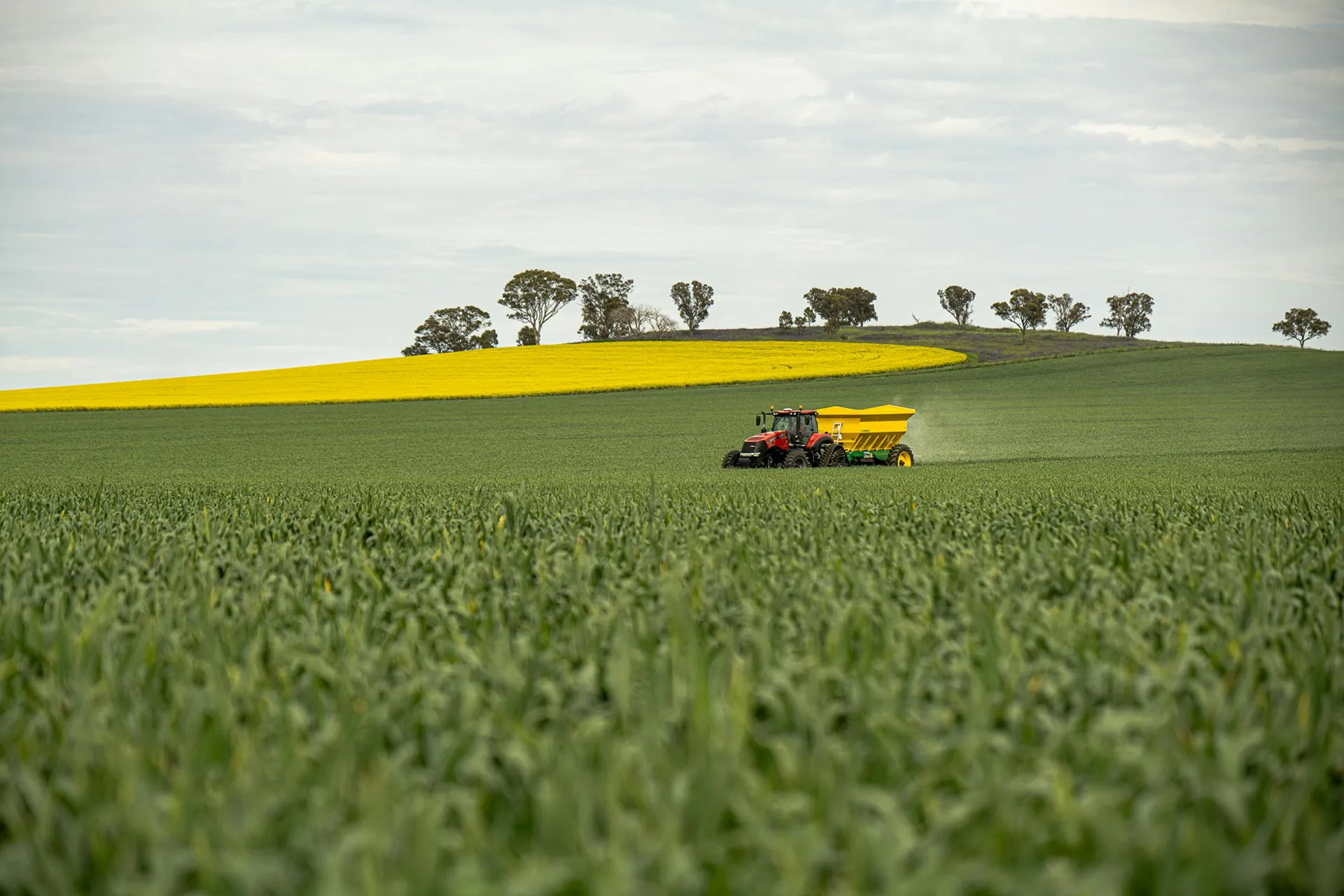
For a lot of Australian farmers, granular fertiliser is what they are familiar with as a traditional
farming method relied on for decades - what the spreader is set up for and what has grown every
crop and pasture on the farm for thirty years or more.
When Paul Cox sits down with a farmer thinking about making the shift to liquid nutrition, he
recommends starting slowly and not changing everything at once.
"It’s a bit of a paradigm shift, doing things a little differently over a period of time to get a better
result."
Nitrogen is not always the element doing the work. Paul’s first observation is usually about what
the pasture is telling him through it leaves and overall condition.
"We might look at a client’s pasture and say, okay it’s looking a bit yellow, so we’ll have to give it
another nitrogen hit. In my experience it is usually sulphur as sulphur has a lot to do with colour as
well."
Magnesium, sulphur and a range of trace elements all shape how a plant performs and how it
looks. When those minerals are available to the plant, your nitrogen goes a great deal further.
Paul also recommends starting by alternating the type of fertiliser being used, not switching all at
once.
He says farmers don’t need to change the whole fertiliser program in one season rather best
practice is to alternate between traditional granular fertilisers then mix it up with the regenerative
liquid foliar fertilisers.
"Instead of putting another application of urea on, put an application of a liquid fertiliser with other
ingredients. This can really help unlock what nutrients already in the soil."
Over successive seasons, in his experience, farmers find they can wind down the number of
applications used over a season and further decrease usage when right mix is nourishing the
entire soil ecosystem crops and pastures are being sown on.
Healthy soils generate healthy plants flowing into the hip pocket and animal health.
What changes in year one
Paul said the first gain clients currently using this system is financial with the benefit being noticed
long before anything comes out of the ground.
"They’re putting their budget into feeding the plant, rather than putting a lot of solid fertiliser down
the chute with the seed at sowing. So if the season goes against them, they haven’t lost all that
money."
From there further benefits to making the shift to a liquid fertiliser depends on the type enterprise.
In a grazing system, the response is quick. Paul tells dairy farmers for example to watch the vat.
"It generally takes two to three days before your fat, your protein and your yield start to improve."
In cropping, the picture builds over a longer arc. Growth stays vigorous, checks in growth ease off,
and insect pressure follows.
Farmers running the program consistently report less disease pressure, fewer weeds and more
mineral density in the grain, which means better eating quality and better storage.
"Don’t expect miracles in the first year. You will see some big changes, but it takes two to three
years before you look at it and say, I don’t have those weed pressures I did three years ago."
Livestock producers see it in the herd. One of Paul’s clients had no pink eye and no calving issues
inside two years and put it down to better mineralised pastures and feed and minerals in the water.
Paul has an image he comes back to often. "Your soil is a bit like a big ocean liner. It takes a lot of
energy to turn it around, but once you start to turn it, it’s very easy. It exponentially goes faster and
faster."
A small tinny turns on almost nothing. Heavier soils are the liner. Sandy loams are the tinny.
Do you need new machinery?
A question that stops most farmers when thinking about making the shift and the answer is short
No.
"Instead of getting the spreader out, the spray tanker is used."
As most farms already run a spray unit for weeds there is no extra outlay. Those that do not can
hook a firefighting pump into a tank on the back of a ute to get the job done.
"It is a mindset shift." Paul’s closing thought is about giving the trial enough room to show you
something.
" Start small but start serious. If a bloke running a 500 cow dairy wants to start with a 20 litre drum,
he’s not really serious. Do enough that you can monitor three or four days grazing on that trial
paddock."